
ASTM A387 Grade 11 Alloy Steel Plate
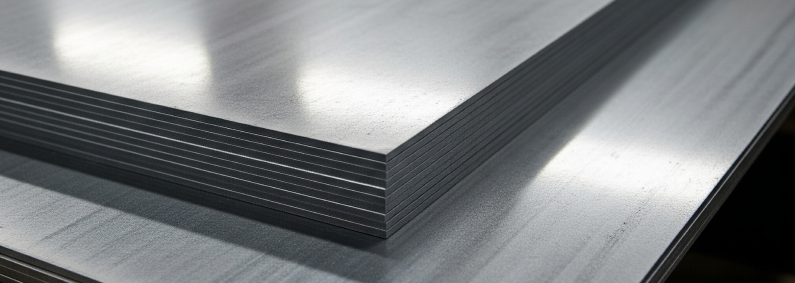
As operating temperatures climb beyond the range of carbon steel, the metallurgy of a pressure vessel plate must evolve with them. ASTM A387 Grade 11 is the answer for equipment that operates in the 300–540 °C range — a chromium-molybdenum (Cr-Mo) alloy steel plate purpose-engineered for elevated temperature pressure vessel and heat exchanger service.
Grade 11 contains nominally 1.25% chromium and 0.5% molybdenum. This combination is not arbitrary — chromium elevates high-temperature oxidation resistance and strengthens the steel against creep, while molybdenum suppresses temper embrittlement and maintains strength as temperature increases.
Within the A387 family — which spans from Grade 2 (0.5% Mo only) through to Grade 91 (9% Cr, 1% Mo) — Grade 11 occupies the lower-alloy position. It delivers a cost-effective upgrade from carbon steel for moderately elevated-temperature duties, without requiring the complex fabrication procedures associated with higher-alloy grades. Refineries, chemical plants, and power facilities routinely specify Grade 11 for hydrotreating reactors, hot oil systems, and high-temperature heat exchangers.
Mechanical Properties
| Property | Class 1 | Class 2 | Unit |
|---|---|---|---|
| Tensile Strength | 515 – 690 | 620 – 795 | MPa |
| Yield Strength (min.) | 310 | 415 | MPa |
| Elongation (min.) | 22 | 18 | % |
| Brinell Hardness (max.) | 197 | 241 | HB |
A387 Gr. 11 is supplied in two strength classes. Class 2 is produced by quenching and tempering; Class 1 is normalized and tempered.
Chemical Composition
| Element | Content (%) |
|---|---|
| Carbon (C) | 0.05 – 0.17 |
| Manganese (Mn) | 0.30 – 0.61 |
| Phosphorus (P) max. | 0.025 |
| Sulfur (S) max. | 0.025 |
| Silicon (Si) | 0.50 – 1.00 |
| Chromium (Cr) | 1.00 – 1.50 |
| Molybdenum (Mo) | 0.44 – 0.65 |
Applications
- Hydrotreating & Hydrocracking Reactors: Shell plates for catalytic hydroprocessing reactor vessels in petroleum refining operating at elevated temperatures and hydrogen partial pressures, where Cr-Mo alloy resists hydrogen attack as defined by API 941 (Nelson Curves).
- High-Temperature Heat Exchangers: Shell and channel plates for feed-effluent exchangers and process gas coolers in refinery and chemical plant hot sections.
- Catalytic Reformer Equipment: Reactor and separator vessels in catalytic reforming units where temperatures regularly exceed 400 °C.
- Hot Oil & Thermal Fluid Systems: Pressure vessels and drums in thermal oil systems for industrial heating, where carbon steel exceeds its safe operating limit.
- Power Generation Boilers: Superheater headers, steam drum shells, and pressure parts in power boilers operating in the 300–450 °C range, where carbon steel creep becomes a concern.
- Pressure Vessels in Chemical Plants: High-temperature reactors, columns, and separators in ammonia synthesis, urea production, and related chemical processing plants.
Elevated Temperature Performance
One of the most important selection criteria for A387 Gr. 11 plate is its retained strength at elevated temperature. Unlike carbon steels whose allowable stresses fall sharply above 350 °C, Cr-Mo steel maintains useful strength to significantly higher temperatures:
| Temperature | Approximate Allowable Stress (ASME VIII) |
|---|---|
| 100 °C | ~138 MPa |
| 300 °C | ~121 MPa |
| 400 °C | ~103 MPa |
| 500 °C | ~69 MPa |
| 540 °C | ~48 MPa |
Values are approximate. Always consult ASME Section II Part D for precise allowable stresses at the design temperature.
Weldability & Processing
- Weldability: Grade 11 requires more attention to the welding procedure than carbon steel grades. Preheating to 175–230 °C is typically required to prevent hydrogen cracking in the heat-affected zone, given the higher alloy content and hardenability. All standard arc welding processes are applicable using matching Cr-Mo filler materials (e.g., E8018-B2 / ER80S-B2).
- Post-Weld Heat Treatment (PWHT): PWHT is mandatory for A387 Gr. 11 in virtually all pressure vessel applications. Stress relief tempering at 675–760 °C restores toughness to the weld heat-affected zone, relieves residual stresses, and eliminates the temper embrittlement susceptibility that can develop in Cr-Mo weld deposits.
- Temper Embrittlement Awareness: Grade 11 Cr-Mo steel is susceptible to temper embrittlement if slowly cooled through the 370–560 °C range. For vessels subject to pressurized startup at low temperatures, impact testing and careful PWHT cooling rates are specified to manage this risk.
Manufacturing Standard
- ASTM A387 / A387M — Standard Specification for Pressure Vessel Plates, Alloy Steel, Chromium-Molybdenum
Quality Assurance
- Mechanical Testing: Mechanical Testing — Tensile, yield strength, and elongation testing is performed per ASTM A370 for both Class 1 and Class 2 material. Charpy V-notch impact testing and hardness verification are conducted where specified, particularly for low-temperature startup or cyclic service conditions.
- Dimensional Accuracy: Dimensional Accuracy — Plates are inspected against ASTM A20 tolerances. Tight thickness and flatness control is essential for precise fit-up in reactor shells and heat exchanger channel sections, where tolerances are closely managed to meet ASME fabrication requirements.
- Weldability Tests: Weldability Tests — Weld procedure qualifications include preheat verification, Charpy impact testing of the heat-affected zone, and hardness surveys to confirm that PWHT has achieved the target post-weld hardness and toughness values.
FAQs
A387 Grade 11 is used for elevated temperature pressure vessels, heat exchangers, and boiler components in petroleum refining, chemical processing, and power generation. It is particularly specified for hydrotreating reactors and hot oil systems operating in the 300–540 °C range, where plain carbon steel would creep or suffer hydrogen attack.
A387 Grade 11 contains 1.00–1.50% chromium and 0.44–0.65% molybdenum. This Cr-Mo chemistry provides the elevated temperature strength, oxidation resistance, and resistance to hydrogen-induced cracking that carbon steels cannot deliver above approximately 300 °C.
Yes. Preheating to 175–230 °C is typically required before welding A387 Gr. 11, depending on plate thickness, carbon content, and joint restraint. The Cr-Mo alloy chemistry increases hardenability relative to carbon steel, making preheat essential to prevent cold cracking in the heat-affected zone.
Yes. ASME SA-387 Gr. 11 is the ASME Boiler and Pressure Vessel Code adoption of ASTM A387 Gr. 11, with identical chemical and mechanical requirements. SA-387 is cited when ASME code compliance is contractually required for the pressure component.

Products
Industry We Serve
- Oil & Gas industries
- Chemical process industries
- Pump and valve in high pressure component
- Food industries
- Pulp and paper industry
- Aerospace industry
- Power plant
- Mechanical component
- Sugar industry
- Cement industry