
ASTM A387 Grade 22 Alloy Steel Plate
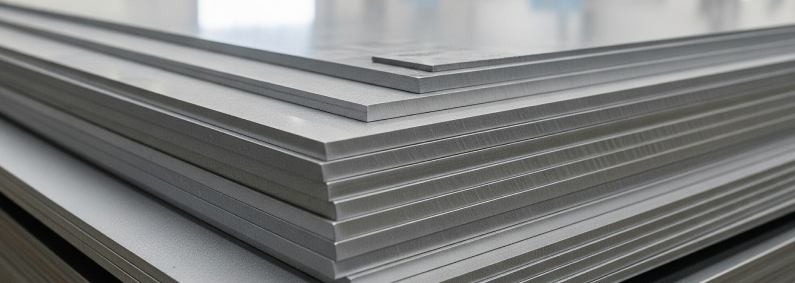
In heavy petroleum refining and high-pressure chemical processing, few materials carry as much engineering responsibility as ASTM A387 Grade 22. This 2.25% chromium, 1.0% molybdenum alloy steel plate is the workhorse of high-temperature, high-pressure reactor vessel construction — positioned prominently on the API 941 Nelson Curves as a material that resists hydrogen attack at conditions that would destroy lower-alloy steels.
Where Grade 11 handles moderately elevated-temperature duties, Grade 22 steps in for the most thermally and chemically demanding pressure vessel applications: hydrocracking reactors, hot hydrogen service equipment, and vessels that must maintain structural integrity at temperatures approaching 600 °C over decades of operation.
A387 Gr. 22 is also notable for its role in heavy-wall reactor fabrication. The ability to produce plates in thicknesses exceeding 200 mm in normalized-and-tempered or quenched-and-tempered condition makes it the material of choice for hydroprocessing reactor shells that must contain hydrogen at high partial pressures and temperatures without wall thinning or embrittlement over a design life measured in decades.
Mechanical Properties
| Property | Class 1 | Class 2 | Unit |
|---|---|---|---|
| Tensile Strength | 515 – 690 | 620 – 795 | MPa |
| Yield Strength (min.) | 310 | 415 | MPa |
| Elongation (min.) | 22 | 18 | % |
| Brinell Hardness (max.) | 197 | 241 | HB |
Class 1 is normalized and tempered. Class 2 is quenched and tempered, providing higher strength for thick-wall reactor applications.
Chemical Composition
| Element | Content (%) |
|---|---|
| Carbon (C) | 0.05 – 0.15 |
| Manganese (Mn) | 0.25 – 0.65 |
| Phosphorus (P) max. | 0.025 |
| Sulfur (S) max. | 0.025 |
| Silicon (Si) max. | 0.50 |
| Chromium (Cr) | 1.90 – 2.60 |
| Molybdenum (Mo) | 0.87 – 1.13 |
The higher Cr and Mo content compared to Grade 11 is the defining distinction, providing superior high-temperature performance and hydrogen attack resistance.
Applications
- Hydrocracking & Hydrotreating Reactors: Heavy-wall reactor shells for catalytic hydroprocessing units in complex oil refineries, where hydrogen partial pressures and temperatures place demands beyond any lower-alloy steel.
- Hot High-Pressure Separators: Shell plates for hot high-pressure and hot low-pressure separator vessels in hydroprocessing units operating above 400 °C.
- Catalytic Reformer Reactors: Reactor shells and heads in semi-regenerative and continuous catalytic reforming (CCR) units where temperatures consistently exceed Grade 11 limits.
- Hydrogen Production Equipment: Pressure vessels in steam methane reforming (SMR) and other hydrogen generation processes where hydrogen partial pressure and temperature are simultaneously elevated.
- Thick-Wall Pressure Vessels: Applications requiring plates above 100 mm thick, where the hardenability of Grade 22 is necessary to achieve through-thickness mechanical properties after heat treatment.
- Power Generation: Steam headers, high-temperature pressure vessels, and boiler components in supercritical and ultra-supercritical power plants at the upper boundary of Grade 22’s approved temperature range.
Grade 11 vs Grade 22 — Selecting the Right Cr-Mo Plate
| Property | A387 Grade 11 | A387 Grade 22 |
|---|---|---|
| Chromium (Cr) | 1.00 – 1.50% | 1.90 – 2.60% |
| Molybdenum (Mo) | 0.44 – 0.65% | 0.87 – 1.13% |
| Max. Service Temp. (approx.) | ~540 °C | ~600 °C |
| Hydrogen Attack Resistance | Moderate (Nelson Curves) | High (Nelson Curves) |
| Creep Resistance | Moderate | High |
| Preheat Requirement | 175–230 °C | 200–260 °C |
| Typical Application | Hot oil, moderate H₂ duty | Hydrocracking, severe H₂ duty |
Weldability & Processing
- Weldability: A387 Gr. 22 is weldable with matching Cr-Mo filler metals (E9018-B3 / ER90S-B3). Preheat requirements are higher than Grade 11, typically 200–260 °C, due to the increased alloy content and hardenability. All arc welding processes are suitable with an appropriate procedure qualification.
- Post-Weld Heat Treatment: PWHT is always required for Grade 22 pressure vessel fabrications. Stress relief at 690–760 °C is standard, with careful control of heating and cooling rates through the temper embrittlement range (370–560 °C). For hydrogen service vessels, PWHT procedures are developed in close coordination with the owner’s engineering specification and API RP 934.
- Temper Embrittlement Management: Grade 22 is susceptible to temper embrittlement, particularly in heavy-wall sections. For hot hydrogen service vessels, API RP 934-A governs material selection, chemistry control (J factor, X-bar), welding consumables, and PWHT to ensure adequate toughness at the minimum pressurization temperature (MPT).
- Thick Plate Fabrication: For Class 2 (Q&T) heavy-wall plates above 100 mm, full-thickness mechanical testing, including Charpy impact testing at multiple through-thickness locations, is typically specified to confirm uniform properties.
Manufacturing Standard
- ASTM A387 / A387M — Standard Specification for Pressure Vessel Plates, Alloy Steel, Chromium-Molybdenum
Quality Assurance
- Mechanical Testing: Mechanical Testing — Tensile and yield testing per ASTM A370 is conducted for both Class 1 and Class 2 material. For a heavy-wall reactor plate, Charpy V-notch impact testing at the minimum pressurization temperature, hardness surveys, and drop weight tear tests may be specified in addition to standard mechanical tests.
- Dimensional Accuracy: Dimensional Accuracy — Given the heavy-wall nature of many Grade 22 applications, plate thickness uniformity and flatness are verified with particular care. Ultrasonic examination (UT) per ASTM A578 or A435 is frequently specified to detect internal laminations and inclusions in thick plates before vessel fabrication begins.
- Weldability Tests: Weldability Tests — Weld procedure qualifications for Grade 22 are governed by ASME IX or equivalent. For hydrogen service applications, HAZ hardness surveys, Charpy testing of the HAZ after PWHT, and step-cooling tests for temper embrittlement evaluation may all be required per API RP 934-A.
FAQs
A387 Grade 22 is used for high-temperature, high-pressure reactor vessels and pressure equipment in oil refining and chemical processing — particularly hydrocracking and hydrotreating reactors operating in hot hydrogen service. It is also used for heavy-wall pressure vessels and high-temperature boiler components where its superior creep resistance and hydrogen attack resistance are required.
A387 Grade 22 contains 1.90–2.60% chromium and 0.87–1.13% molybdenum, commonly referred to as 2.25Cr-1Mo steel. This chemistry places it significantly higher on the API 941 Nelson Curves compared to Grade 11, allowing use at higher hydrogen partial pressures and temperatures without risk of hydrogen-induced embrittlement.
API 941 defines the safe operating limits for steel in hydrogen service as a function of temperature and hydrogen partial pressure. Grade 22 (2.25Cr-1Mo) sits on a higher curve than Grade 11 (1.25Cr-0.5Mo), meaning it can safely operate at higher temperatures and hydrogen partial pressures. This is the primary reason Grade 22 is specified for hydroprocessing reactors rather than Grade 11.
Yes, without exception for pressure vessel service. PWHT at 690–760 °C is required after welding to relieve residual stresses, restore HAZ toughness, and minimize susceptibility to stress corrosion cracking and hydrogen-induced cracking. For hot hydrogen service, PWHT procedures follow API RP 934-A guidelines, which include strict controls on chemistry, heating rates, soaking temperature, and cooling rates through the embrittlement range.
ASME Section II Part D permits A387 Gr. 22 (SA-387 Gr. 22) for service up to approximately 600–650 °C, depending on the class and applicable code case. Above this range, higher-alloy steels such as A387 Grade 91 (9Cr-1Mo-V) are required. At the upper end of Grade 22’s approved range, allowable stresses are significantly reduced relative to ambient values — the design engineer must verify using ASME Section II Part D tables.

Products
Industry We Serve
- Oil & Gas industries
- Chemical process industries
- Pump and valve in high pressure component
- Food industries
- Pulp and paper industry
- Aerospace industry
- Power plant
- Mechanical component
- Sugar industry
- Cement industry