
S355 Carbon Steel Sheets and Plates
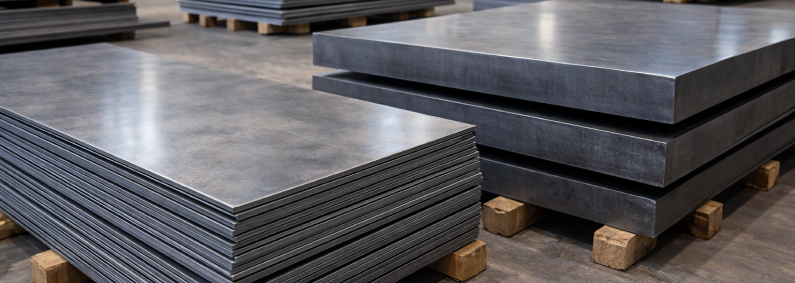
Ask any structural engineer in Europe to name the structural steel plate specification they use most often, and the answer will almost always be the same: S355. It is the grade that modern structural codes are built around, the plate that fabrication shops stock as standard, and the material that connects the design assumptions of EN 1993 (Eurocode 3) to physical steel on the cutting table.
S355 sheets and plates are produced to EN 10025-2, the European hot-rolled structural steel standard. The “S” designates structural steel; “355” is the minimum yield strength in MPa at a thickness up to 16 mm. What elevates S355 above a simple strength specification is its sub-grade system — JR, J0, J2, and K2 — which allows engineers to select the exact combination of strength and impact toughness required for the specific temperature and loading profile of their project. A bridge deck plate in a temperate climate might specify S355JR; a topside structure on a North Sea platform will specify S355J2 or K2.
In sheet and plate form, S355 is available across a wide thickness range and in multiple surface and heat treatment conditions. For structural design engineers, the familiar and well-documented mechanical properties of S355 remove uncertainty from material selection — the grade has been tested, simulated, and validated in structural analysis software across millions of projects.
Mechanical Properties
| Property | ≤ 16 mm | 16–40 mm | 40–63 mm | 63–80 mm | Unit |
|---|---|---|---|---|---|
| Tensile Strength | 470–630 | 470–630 | 470–630 | 470–630 | MPa |
| Yield Strength (min.) | 355 | 345 | 335 | 325 | MPa |
| Elongation (min.) | 22 | 22 | 21 | 20 | % |
| Brinell Hardness | 152–187 | 152–187 | 152–187 | 152–187 | HB |
| Density | 7.85 | — | — | — | g/cm³ |
Yield strength reduces with increasing thickness as per EN 10025-2 Table 7. This thickness reduction must be used in structural calculations.
Sub-Grade Selection Guide
| Sub-Grade | Impact Test Temp. | Impact Energy | Best Use Case |
|---|---|---|---|
| S355JR | +20 °C | 27 J min. | General construction, warm or temperate climates |
| S355J0 | 0 °C | 27 J min. | Moderate cold environments, standard European projects |
| S355J2 | −20 °C | 27 J min. | Cold climates, dynamic loading, offshore topsides |
| S355K2 | −20 °C | 40 J min. | High-dynamic or fatigue-governed structures |
All sub-grades have identical strength values. The “+N” suffix (e.g., S355J2+N) indicates a normalized delivery condition.
Chemical Composition
| Element | Max. % (t ≤ 16 mm) |
|---|---|
| Carbon (C) | 0.24 |
| Silicon (Si) | 0.55 |
| Manganese (Mn) | 1.60 |
| Phosphorus (P) | 0.035 |
| Sulfur (S) | 0.035 |
| Nitrogen (N) | 0.012 |
| Carbon Equivalent (CE) | 0.43 max |
Applications
- Primary Structural Frames: Columns, beams, plate girders, and connection plates in multi-storey commercial and industrial buildings where Eurocode design demands reliable 355 MPa yield.
- Bridge Deck & Girder Plates: Main girder flange and web plates, cross-girder plates, and deck stiffening plates in road, rail, and pedestrian bridges designed to EN 1993-2.
- Offshore Platform Structures: Topside deck plating, module support frames, and equipment foundations on offshore oil and gas installations where S355J2 or K2 is the minimum structural specification.
- Wind Turbine Foundations: Monopile and jacket structure plates for offshore wind turbine foundations, where fatigue-governed design and marine environment resistance determine sub-grade selection.
- Heavy Industrial Structures: Mill building frames, conveyor gantries, blast furnace structures, and refinery structural steel, where large plate areas and demanding load profiles are standard.
- Shipbuilding Structural Plates: Hull frames, transverse bulkheads, and main deck plates in offshore support vessels and large commercial ships classified under Lloyd’s, DNV, or Bureau Veritas rules.
Plate Delivery Conditions
- +AR (As-Rolled): Standard condition. Suitable for most structural applications at normal thickness ranges.
- +N (Normalized): Normalized rolling or normalizing heat treatment. Provides improved and more consistent toughness, required for S355J2+N. Recommended for plates above 40 mm.
- +M (Thermo-Mechanically Rolled): Thermo-mechanical controlled processing (TMCP). Achieves improved toughness without normalizing heat treatment. Suitable for moderate thickness ranges with enhanced impact properties.
Weldability & Processing
S355 plate welds well across all standard arc welding processes. A carbon equivalent of up to 0.43 means preheat is not required for plates up to 25 mm at ambient temperature. Preheat of 75–100 °C applies for 25–50 mm plates, and 100–150 °C for plates above 50 mm. Post-weld heat treatment is not required for structural use but may be specified for specific engineering applications.
Manufacturing Standard
- EN 10025-2 — Hot rolled products of structural steels — Technical delivery conditions for non-alloy structural steels
Quality Assurance
- Mechanical Testing: Mechanical Testing — Tensile, yield, and elongation testing is performed per EN 10002-1 / ISO 6892-1 for every heat. Charpy V-notch impact testing at the specified sub-grade temperature is conducted per EN 10045-1, with results demonstrating compliance with the 27 J or 40 J minimum requirement. Yield strength values are recorded against actual plate thickness to confirm thickness-dependent compliance.
- Dimensional Accuracy: Dimensional Accuracy — Plates are inspected for thickness, width, length, flatness, and squareness per EN 10029 (plate) and EN 10051 (strip/sheet) tolerances. Normalized and TMCP plates receive additional flatness checks, since heat treatment can introduce residual stresses that affect plate flatness.
- Weldability Tests: Weldability Tests — Weld procedure qualifications follow EN ISO 15614-1. For S355J2 and K2 material used in impact-critical structures, HAZ Charpy impact testing is conducted alongside tensile and bend tests to confirm that the welded joint, not just the base plate, meets the specified toughness level.
FAQs
S355 plate is used for primary structural frames in buildings and bridges, offshore platform decking, wind turbine foundations, heavy industrial structures, and shipbuilding. It is Europe’s most specified structural steel plate, chosen wherever a combination of high strength and reliable weldability is the design requirement.
S355 has a minimum yield strength of 355 MPa for plates up to 16 mm thick. This reduces progressively with thickness, to 345 MPa for 16–40 mm, 335 MPa for 40–63 mm, and 325 MPa for 63–80 mm, as specified in EN 10025-2. Structural calculations must use the yield strength corresponding to the actual plate thickness being designed.
Both sub-grades have identical tensile and yield strength. The difference is impact toughness: S355JR is Charpy tested at +20 °C, while S355J2 is tested at −20 °C. S355J2 is the correct specification for structures in cold climates, offshore applications, and where dynamic or fatigue loading is a design consideration.
The “+N” suffix indicates the plate was supplied in the normalized condition — either by normalizing heat treatment or normalized rolling. Normalized S355 plate has a more refined and uniform grain structure, providing improved and consistent toughness, particularly for plates above 40 mm thick. S355J2+N is the most commonly specified normalized structural plate for demanding applications.
Yes. S355J2 and S355K2 are both widely used for offshore topside structures, with S355K2 specified where higher impact energy (40 J at −20 °C) is required. For primary structural members on jacket structures or subsea foundations, project specifications may additionally require Z-grade material (S355J2+Z35) to prevent lamellar tearing in through-thickness loaded connections.

Products
Industry We Serve
- Oil & Gas industries
- Chemical process industries
- Pump and valve in high pressure component
- Food industries
- Pulp and paper industry
- Aerospace industry
- Power plant
- Mechanical component
- Sugar industry
- Cement industry