
API 5L PSL2 Line Pipes
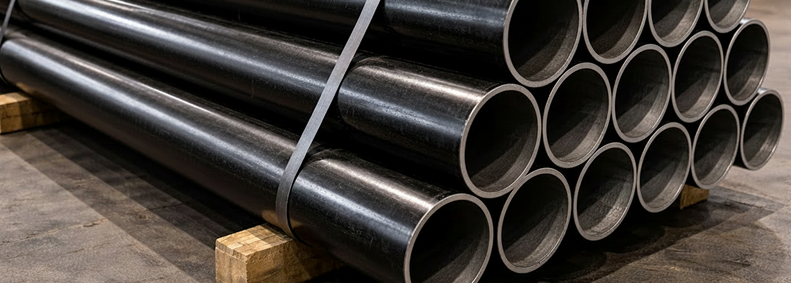
For pipeline systems where strict quality control, enhanced mechanical performance, and safety compliance are essential, API 5L PSL2 line pipes are the preferred choice. PSL2 (Product Specification Level 2) represents a higher quality level under the API 5L standard, with more stringent requirements compared to PSL1.
PSL2 pipes are specifically designed for critical oil and gas transmission systems, including offshore pipelines and high-pressure environments. They feature tighter control over chemical composition, mandatory impact testing, and additional inspection requirements to ensure reliability under demanding conditions.
These pipes are widely used in EPC projects, international pipeline systems, and high-risk environments where failure is not an option.
Mechanical Properties
| Property | Value Range | Unit |
|---|---|---|
| Yield Strength | 290 – 550+ | MPa |
| Tensile Strength | 415 – 760 | MPa |
| Elongation | ≥ 20 | % |
| Impact Strength | Mandatory | — |
| Hardness | ~130 – 230 | HB |
| Density | 7.85 | g/cm³ |
| Modulus of Elasticity | 200 | GPa |
Chemical Composition
| Element | Typical Limit (%) |
|---|---|
| Carbon (C) | Lower than PSL1 |
| Manganese (Mn) | Controlled |
| Phosphorus (P) | ≤ 0.025 |
| Sulfur (S) | ≤ 0.015 |
PSL2 requires stricter limits to ensure better toughness and weldability.
Available Grades
PSL2 pipes are available in:
Applications
- High-Pressure Oil & Gas Pipelines: Long-distance transmission of hydrocarbons under high pressure and demanding operating conditions.
- Offshore & Subsea Pipelines: Used in offshore installations where reliability and safety are critical due to harsh environments.
- Refineries & Petrochemical Plants: Process pipelines handling pressurized fluids and gases.
- Cross-Country Pipelines: Large-scale infrastructure projects requiring strict quality and inspection standards.
- Sour Service Applications: Suitable for environments containing hydrogen sulfide (H₂S) with proper specifications.
- EPC & International Projects: Preferred for projects requiring strict compliance, traceability, and certification.
Weldability & Processing
Weldability:
PSL2 pipes are designed for high-quality welding with controlled chemistry.
- Requires qualified welding procedures
- Preheating may be necessary depending on the thickness
Fabrication Considerations:
- Suitable for advanced pipeline construction
- Requires adherence to strict welding and inspection standards
Quality Assurance
- Mechanical Testing: PSL2 pipes undergo extensive testing, including yield strength, tensile strength, elongation, and mandatory impact testing. These tests ensure performance under critical operating conditions. Additional testing ensures reliability in high-pressure and low-temperature environments.
- Dimensional Accuracy: Strict dimensional inspection ensures compliance with tighter tolerances compared to PSL1. Accuracy is critical for pipeline integrity and installation. Precise dimensions improve alignment, reduce stress concentrations, and enhance system performance.
- Weldability Tests: PSL2 pipes are evaluated for weldability to ensure high-quality weld joints in critical pipeline systems. Welding performance directly impacts safety and reliability. Controlled composition and qualified procedures ensure strong, defect-free welds suitable for demanding applications.
FAQs
PSL2 pipes require detailed documentation, including Mill Test Certificates, heat treatment records, and impact test reports. Traceability from raw material to finished product is mandatory. EPC contractors may also require third-party inspection reports and compliance certificates. Documentation plays a key role in project approval.
PSL2 pipes have stricter chemical composition limits, especially for sulfur and phosphorus, improving resistance to cracking in sour environments. This makes them suitable for applications involving H₂S exposure when combined with additional specifications like NACE compliance. Proper material selection is critical.
Impact testing ensures that the material can withstand sudden loads and low-temperature conditions without brittle failure. This is critical in high-risk environments. It improves reliability in pipelines exposed to fluctuating temperatures and pressure conditions. This is a key differentiator from PSL1.
PSL2 pipes have stricter acceptance criteria, which may lead to higher rejection rates during inspection. This ensures only high-quality material is supplied. While this may slightly increase cost and lead time, it significantly improves reliability. It is essential for critical pipeline systems.
Third-party inspection ensures compliance with project specifications and international standards. It is often mandatory in EPC and export projects. Inspectors verify testing, dimensions, and documentation before dispatch. This reduces risk and ensures acceptance at the project site.

Products
Industry We Serve
- Oil & Gas industries
- Chemical process industries
- Pump and valve in high pressure component
- Food industries
- Pulp and paper industry
- Aerospace industry
- Power plant
- Mechanical component
- Sugar industry
- Cement industry