
ASTM A516 Grade 70 Boiler Plate
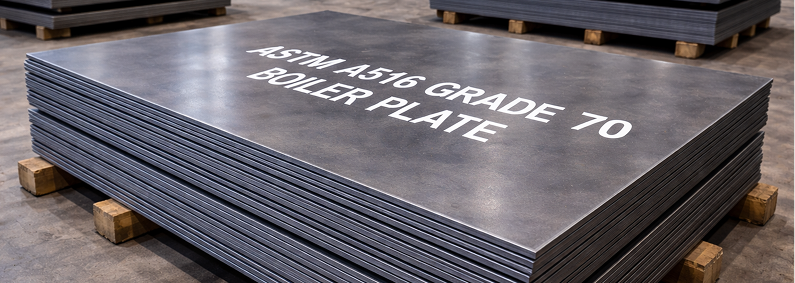
If there is one boiler and pressure vessel plate that dominates global procurement lists, it is ASTM A516 Grade 70. Across refineries, gas processing plants, power stations, and chemical facilities on every continent, Gr. 70 has become the default specification for boiler shells, pressure vessel shells, heads, and nozzle pads — and for good reason.
ASTM A516 Grade 70 is the highest-strength grade within the A516 pressure vessel and boiler plate family, which also includes ASTM A516 Grade 60 for applications requiring slightly lower strength levels. It delivers a tensile range of 485–620 MPa and a minimum yield strength of 260 MPa, providing the combination of pressure-bearing capacity and material toughness that most boiler and vessel design codes are built around.
Critically, A516 Gr. 70 is not just a strong plate — it is a tough one. Produced to fine-grain practice with controlled silicon content, it maintains reliable notch toughness at temperatures well below ambient, making it suitable for a wide range of boiler and pressure applications. This is why ASME SA-516 Grade 70 is widely referenced in ASME Section I (boilers) and Section VIII Div. 1 (pressure vessels) as the go-to carbon steel material.
Mechanical Properties
| Property | Value | Unit |
|---|---|---|
| Tensile Strength | 485 – 620 | MPa |
| Yield Strength (min.) | 260 | MPa |
| Elongation in 200 mm (min.) | 17 | % |
| Elongation in 50 mm (min.) | 21 | % |
| Brinell Hardness | 137 – 187 | HB |
| Density | 7.85 | g/cm³ |
| Modulus of Elasticity | 200 | GPa |
Chemical Composition
| Element | Max. Content (%) |
|---|---|
| Carbon (C) | 0.24 (t ≤ 13 mm) / 0.27 (13–51 mm) / 0.28 (51–102 mm) / 0.31 (> 102 mm) |
| Manganese (Mn) | 0.85 – 1.20 |
| Phosphorus (P) | 0.035 |
| Sulfur (S) | 0.035 |
| Silicon (Si) | 0.13 – 0.45 |
Applications
A516 Gr. 70 is the industry-standard specification for boiler plates and pressure-containing equipment:
- Boiler Shells & Drums — Primary material for steam boiler shells, steam drums, and water tube boiler components under ASME Section I.
- Pressure Vessel Shells & Heads — Cylindrical shells, hemispherical and ellipsoidal heads, and conical transitions.
- High-Pressure Storage Tanks — LPG, compressed air, and industrial gas storage vessels.
- Heat Exchangers — Shell plates, channel covers, and floating head components.
- Reactor Vessels — Used in chemical processing, fertilizer plants, and refineries.
- Offshore Boiler & Pressure Systems — Equipment requiring strict traceability and ASME compliance.
Weldability & Processing
- Weldability: A516 Gr. 70 boiler plate welds reliably using standard arc welding processes. Its controlled chemistry and fine-grain structure maintain a moderate carbon equivalent, minimizing hardening in the heat-affected zone.
1) Up to 19 mm: No preheat typically required
2) 19–38 mm: 80–100 °C preheat
3) Above 38 mm: 100–150 °C preheat - Post-Weld Heat Treatment (PWHT): PWHT is commonly applied in boiler fabrication to relieve residual stresses, especially for:Thick plates (>38 mm) Hydrogen or sour service High-pressure boiler applications
- Normalizing: Normalized A516 Gr. 70 (Gr. 70N) improves Charpy impact toughness and is preferred for:Low-temperature boiler service Critical pressure applications
- Cold Forming: Widely used for forming boiler shells, dished ends, and heads. Post-forming heat treatment may be required as per ASME guidelines.
A516 Grade 60 vs Grade 70 — Key Differences
| Property | ASTM A516 Grade 60 | ASTM A516 Grade 70 |
|---|---|---|
| Tensile Strength | 415 – 550 MPa | 485 – 620 MPa |
| Yield Strength (min.) | 220 MPa | 260 MPa |
| Carbon Content (max.) | Lower | Higher |
| Low-Temp. Toughness | Slightly better | Good (fine grain) |
| Best Use Case | Moderate pressure | High-pressure boilers |
| Wall Thickness | Thicker | Thinner |
Manufacturing Standards & Equivalents
- ASTM A516
- ASME Equivalent: SA-516 Grade 70
Quality Assurance
- Mechanical Testing: Each plate is tested for tensile strength (485–620 MPa), yield strength (min. 260 MPa), and elongation per ASTM A370. Charpy impact testing is conducted when specified.
- Dimensional Accuracy: Plates conform to ASTM A20 tolerances for thickness, flatness, width, and length.
- Weldability Tests: Weld procedures are qualified as per ASME Section IX, ensuring strength and ductility across weld joints.
FAQs
A516 Grade 70 is the most widely used boiler plate for steam boilers, pressure vessels, and storage tanks. It is the standard material for ASME Section I boiler components and Section VIII pressure vessels across industries. It is especially preferred where both strength and toughness are required under fluctuating pressure and temperature conditions.
Under ASME codes, it is suitable up to 454 °C (850 °F). Above this, alloy steels are recommended due to creep considerations. At temperatures beyond this limit, mechanical properties begin to degrade due to long-term exposure. Designers must refer to allowable stress values in ASME Section II Part D for accurate design calculations.
ASTM A516 Grade 70 offers higher tensile and yield strength, enabling thinner boiler shells and reduced weight, while Grade 60 offers slightly better ductility. In practical terms, Grade 70 is selected for high-pressure applications where material efficiency is critical. ASTM A516 Grade 60 is often used in moderate-pressure or lower-stress environments where forming and toughness are prioritized.
PWHT is required for thicker plates (>38 mm), hydrogen service, and critical boiler applications as per ASME guidelines. It helps relieve residual stresses from welding and improves resistance to stress corrosion cracking. In many refinery and sour service applications, PWHT is mandatory as per project specifications.
Yes, down to −29 °C without mandatory testing. For lower temperatures, impact testing or normalized plates (Gr. 70N) are recommended. Normalized material provides improved and more consistent Charpy impact values across thicknesses. For critical low-temperature service, engineers often specify additional testing to ensure performance reliability.

Products
Industry We Serve
- Oil & Gas industries
- Chemical process industries
- Pump and valve in high pressure component
- Food industries
- Pulp and paper industry
- Aerospace industry
- Power plant
- Mechanical component
- Sugar industry
- Cement industry