
ST37 Pipes and Tubes
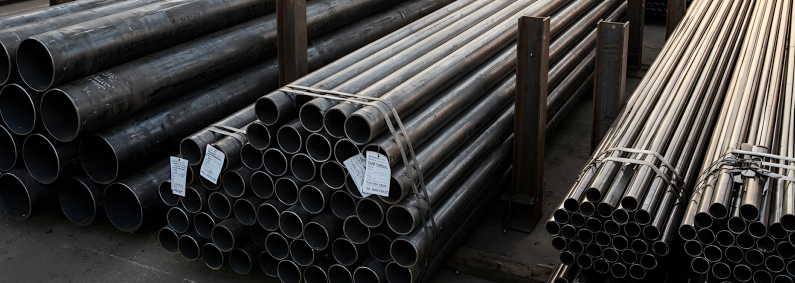
For applications where ease of fabrication and cost efficiency are priorities, ST37 pipes and tubes remain one of the most widely used mild steel options. Known for its low carbon content and dependable mechanical properties, ST37 is extensively used in structural and general engineering applications.
ST37 belongs to the DIN standard family and is typically classified as a mild carbon steel grade. Unlike higher-strength steels, its primary advantage lies in excellent machinability, weldability, and formability, making it ideal for fabrication processes involving bending, cutting, and welding.
Because of its versatility and availability, ST37 pipes and tubes are commonly selected for non-critical load-bearing structures and applications where extreme strength is not required, but consistency and ease of processing are essential.
Mechanical Properties
| Property | Value | Unit |
|---|---|---|
| Yield Strength (min.) | ~235 | MPa |
| Tensile Strength | 360 – 510 | MPa |
| Elongation | 20 – 26 | % |
| Hardness | ~120 – 160 | HB |
| Density | 7.85 | g/cm³ |
| Modulus of Elasticity | 200 | GPa |
Chemical Composition
| Element | Max. Content (%) |
|---|---|
| Carbon (C) | ≤ 0.17 |
| Manganese (Mn) | ≤ 1.40 |
| Silicon (Si) | ≤ 0.35 |
| Phosphorus (P) | ≤ 0.045 |
| Sulfur (S) | ≤ 0.045 |
The low carbon percentage contributes to high ductility and easy weldability.
Equivalent Grades
ST37 pipes and tubes are often compared with:
- IS 2062 E250
- ASTM A36
Equivalents may vary slightly based on composition and mechanical requirements.
Applications
- Light Structural Frameworks: Used in secondary structural elements such as supports, brackets, and frames where high strength is not the primary requirement but dimensional stability is essential.
- Fabrication & Workshop Applications: Ideal for small to mid-scale fabrication units producing gates, railings, sheds, and custom steel assemblies requiring frequent cutting, welding, and shaping.
- Automotive & OEM Components: Utilized in non-load-critical automotive parts, tubular assemblies, and support structures where ease of machining and forming is important.
- Agricultural & Rural Infrastructure: Commonly used in irrigation systems, fencing structures, and farm equipment, where durability and low cost are key decision factors.
- Mechanical & Equipment Structures: Suitable for machine frames, enclosures, and base structures that require moderate strength and high fabrication flexibility.
- Utility & Piping Supports: Used as support pipes in industrial setups for cable trays, piping systems, and HVAC frameworks.
Weldability & Processing
Weldability:
ST37 offers excellent weldability across all common welding processes without requiring special precautions.
- No preheat required for most applications
- Minimal risk of cracking during welding
Formability:
Highly suitable for:
- Cold bending
- Rolling
- Cutting and shaping
Its softness allows easy forming into complex shapes.
Machinability:
ST37 is easy to machine, making it suitable for drilling, threading, and cutting operations.
ST37 vs Higher Strength Grades
| Property | ST37 | S355 / E350 |
|---|---|---|
| Yield Strength | ~235 MPa | ~350 MPa |
| Strength | Lower | Higher |
| Fabrication Ease | Excellent | Moderate |
| Cost | Lower | Higher |
| Best Use | Light structures | Heavy-duty structures |
Quality Assurance
- Mechanical Testing: Each batch of ST37 pipes and tubes is tested for tensile strength, yield strength, and elongation in accordance with applicable DIN/IS standards. These tests ensure the material meets the required mechanical performance for fabrication and structural applications.
- Dimensional Accuracy: Pipes and tubes are inspected for dimensional tolerances, including outer diameter, wall thickness, length, and straightness. Maintaining tight dimensional control is essential for ensuring proper fit-up during fabrication and assembly.
- Weldability Tests: ST37 material is evaluated for weldability through standard welding procedures to ensure compatibility with common fabrication practices such as arc, MIG, and TIG welding. The low carbon content supports smooth welding with minimal risk of cracking or distortion, making it suitable for high-volume fabrication and general engineering applications.
FAQs
ST37 pipes and tubes are primarily used in light structural applications and general fabrication work. They are suitable where strength requirements are moderate and ease of fabrication is important. They are commonly used in workshops, small-scale fabrication, and infrastructure support systems.
No, ST37 is not recommended for high-pressure or high-temperature applications. It is designed for general structural use rather than pressure service. For such requirements, higher-grade materials like API or ASTM pressure pipe grades should be used. Always match the grade to the operating conditions.
ST37 is considered roughly equivalent to IS 2062 E250 in terms of strength and application. Both are mild steel grades used for structural purposes. However, slight variations in composition and standards may exist. It is important to check specifications when substituting between grades.
Yes, ST37 pipes are highly weldable due to their low carbon content. They can be welded using standard welding techniques. No special preheating or post-weld treatment is typically required. This makes them ideal for fabrication-heavy applications.
ST37 can be used outdoors but requires proper surface protection, such as painting or coating. It does not have inherent corrosion resistance. Without protection, it may rust over time when exposed to moisture and environmental conditions. Protective coatings extend their service life.

Products
Industry We Serve
- Oil & Gas industries
- Chemical process industries
- Pump and valve in high pressure component
- Food industries
- Pulp and paper industry
- Aerospace industry
- Power plant
- Mechanical component
- Sugar industry
- Cement industry