
API 5L PSL1 Line Pipes
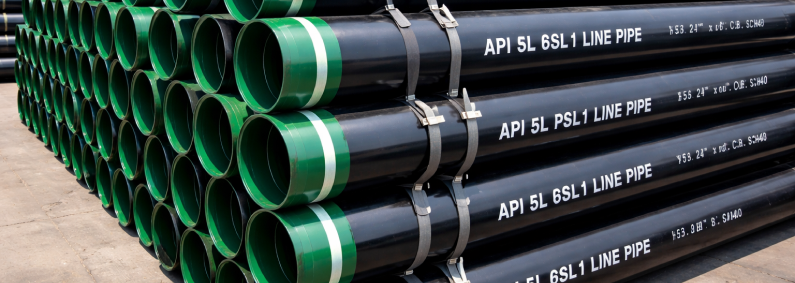
For pipeline projects where standard quality requirements and cost efficiency are key considerations, API 5L PSL1 line pipes are widely used. PSL1 (Product Specification Level 1) represents the baseline quality level under the API 5L standard, covering essential mechanical and chemical requirements for line pipe applications.
API 5L PSL1 pipes are primarily used for the transportation of oil, gas, and water in pipeline systems where operating conditions are moderate and do not demand enhanced testing or strict compliance requirements associated with PSL2.
Available in multiple grades such as X42, X52, X60, and X65, PSL1 pipes provide flexibility for various project requirements while maintaining cost competitiveness. Their widespread use in onshore pipelines and utility systems makes them a practical choice for large-scale infrastructure projects.
Mechanical Properties
| Property | Value Range | Unit |
|---|---|---|
| Yield Strength | 290 – 450+ | MPa |
| Tensile Strength | 415 – 760 | MPa |
| Elongation | ≥ 20 | % |
| Hardness | ~120 – 220 | HB |
| Density | 7.85 | g/cm³ |
| Modulus of Elasticity | 200 | GPa |
Properties vary depending on grade (X42, X52, X65, etc.).
Chemical Composition
| Element | Typical Range (%) |
|---|---|
| Carbon (C) | ≤ 0.28 |
| Manganese (Mn) | ≤ 1.40 |
| Phosphorus (P) | ≤ 0.030 |
| Sulfur (S) | ≤ 0.030 |
PSL1 allows relatively flexible chemistry compared to PSL2, making it easier to manufacture and more cost-effective.
Available Grades
API 5L PSL1 pipes are supplied in multiple grades:
Applications
- Oil & Gas Transmission (Onshore): Used for transportation of crude oil and natural gas in onshore pipeline networks with moderate operating conditions.
- Water Pipeline Systems: Suitable for bulk water transmission, irrigation systems, and municipal pipeline networks.
- Utility & Industrial Pipelines: Used for transporting non-critical fluids in industrial plants and infrastructure projects.
- Distribution Networks: Applied in regional distribution pipelines where high-end testing and certification are not mandatory.
- Low to Medium Pressure Systems: Ideal for applications where pressure and environmental conditions are within standard limits.
- Infrastructure Projects: Pipeline systems in construction, mining, and general industrial sectors.
Weldability & Processing
Weldability:
PSL1 pipes offer good weldability due to moderate carbon content.
- Standard welding processes can be used
- Minimal preheat required in most cases
Fabrication Considerations:
- Suitable for cutting, bending, and joining
- Easy to handle in large-scale pipeline installations
Quality Assurance
- Mechanical Testing: PSL1 pipes are tested for yield strength, tensile strength, and elongation as per API 5L requirements. These tests ensure the material meets baseline mechanical performance for pipeline applications. Testing is conducted to confirm suitability for standard operating conditions in fluid transmission systems.
- Dimensional Accuracy: Pipes are inspected for outer diameter, wall thickness, length, and straightness to ensure compliance with API tolerances. Dimensional consistency is essential for proper alignment and welding in pipeline installations.
- Weldability Tests: Material is evaluated for weldability to ensure compatibility with standard pipeline welding practices. Proper weld performance is essential for maintaining pipeline integrity. Controlled composition supports reliable welding, enabling defect-free joints in field and shop fabrication.
FAQs
PSL1 significantly reduces procurement costs due to relaxed testing and inspection requirements. This makes it suitable for large-scale projects where budget constraints are critical. However, lower upfront cost must be balanced against project risk and performance requirements.
PSL1 usually involves standard mill testing without mandatory third-party inspection. Visual inspection, dimensional checks, and basic mechanical testing are common. For infrastructure projects, buyers may still request additional inspection based on internal quality standards. This depends on project complexity and end-use criticality.
Yes, PSL1 pipes are commonly used in water supply, irrigation, and utility pipelines in public sector projects. They meet standard performance requirements for such applications. However, specifications vary across tenders, and some projects may mandate higher grades or PSL2. Always verify tender documents before procurement.
PSL1 pipes are not recommended for highly critical or hazardous applications due to limited testing requirements. They may not meet stringent safety or compliance standards. For high-pressure or sour service environments, PSL2 is generally specified. Proper grade selection is essential to avoid operational risks.
PSL1 pipes are widely available across mills, resulting in shorter lead times. This makes them suitable for fast-track projects. Bulk availability also helps in price negotiation and supply flexibility. However, availability may vary depending on grade and size.

Products
Industry We Serve
- Oil & Gas industries
- Chemical process industries
- Pump and valve in high pressure component
- Food industries
- Pulp and paper industry
- Aerospace industry
- Power plant
- Mechanical component
- Sugar industry
- Cement industry