
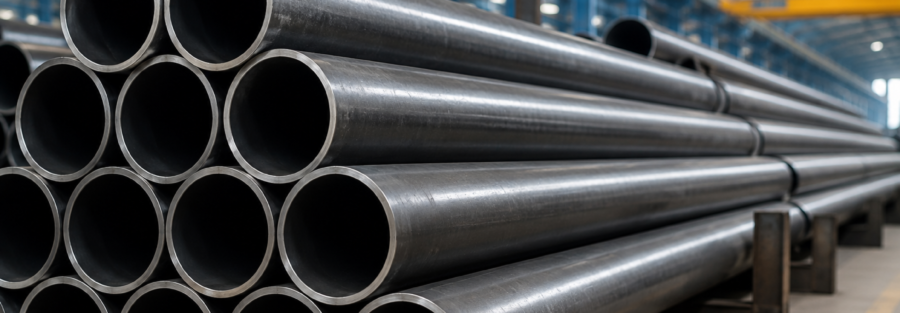
IBR Pipes Welding and Installation — Why Getting It Right Matters
Every weld on an IBR pipe is a safety-critical joint. A poorly welded IBR pipe joint in a boiler steam system does not just leak — it can cause catastrophic failure, pressure vessel explosion, and serious injury under Indian law. As a trusted IBR pipes manufacturer in Mumbai, Riyaarth Overseas supplies IBR-certified pipes and supports buyers with the technical knowledge needed to ensure every installation meets Indian Boiler Regulations 1950 compliance from procurement to commissioning.
This guide covers IBR pipe welding procedures, installation best practices, inspection requirements, and the compliance steps that every contractor, fabricator, and plant engineer must follow.
What Makes IBR Pipe Welding Different from Standard Pipe Welding
IBR pipe welding is not governed by the same rules as general industrial piping. The Indian Boiler Regulations 1950 impose specific requirements on every aspect of the welding process — from welder qualification to post-weld heat treatment to inspection and documentation.
Key differences from standard pipe welding:
Welder Qualification: Every welder working on IBR pipes must hold a valid IBR welder certificate issued by the Chief Inspector of Boilers in the relevant Indian state. An unqualified welder cannot legally weld IBR pipes regardless of their general welding skill level.
Approved Welding Procedure Specification (WPS): The welding procedure must be qualified through a Procedure Qualification Record (PQR) tested to the satisfaction of the IBR inspecting authority. No ad-hoc welding procedures are permitted on IBR systems.
Third-Party Inspection: Every weld joint on IBR pipes must be inspected and accepted by an approved IBR inspecting authority (IA) before the system is commissioned or pressure tested.
Documentation Trail: Every weld joint must be recorded in a weld map with individual weld numbers, welder identity, visual inspection results, NDT results, and the IA’s acceptance stamp.
IBR Pipe Welding Best Practices — Step by Step
Step 1 — Material Verification Before Welding
Never begin welding without confirming the material. Check that every pipe carries a heat number matching the IBR Form II certificate. Perform PMI (Positive Material Identification) testing for alloy steel grades like P11, P22, and P91 to confirm the grade before welding begins. Using the wrong grade in an IBR system is a serious compliance failure that invalidates the entire installation.
Step 2 — Joint Preparation
Proper joint preparation is the foundation of a sound IBR weld:
Pipe end preparation: Bevel pipes to the angle specified in the approved WPS — typically 37.5 degrees with a 1.6mm root face for butt joints in carbon steel IBR pipes.
Cleanliness: Remove all scale, rust, oil, paint, and moisture from the pipe ends and the surrounding zone to at least 25mm on each side of the joint.
Fit-up and alignment: Pipe misalignment must not exceed 1.5mm for pipes below 25mm wall thickness. Use alignment clamps and tack welds at minimum four equidistant positions around the joint circumference.
Root gap: Maintain consistent root gap as specified in the WPS — typically 2mm to 4mm depending on pipe OD and wall thickness.
Step 3 — Preheat Requirements for IBR Pipes
Preheating prevents hydrogen-induced cracking and ensures adequate fusion in the weld zone. Preheat requirements vary by grade and wall thickness:
| Material Grade | Wall Thickness | Minimum Preheat |
|---|---|---|
| Carbon Steel A106 Gr. B | Below 25mm | 10°C minimum ambient |
| Carbon Steel A106 Gr. B | Above 25mm | 100°C to 150°C |
| P11 (1.25Cr-0.5Mo) | All thicknesses | 150°C to 200°C |
| P22 (2.25Cr-1Mo) | All thicknesses | 200°C to 250°C |
| P91 (9Cr-1Mo-V) | All thicknesses | 200°C to 300°C |
Preheat must be measured using contact thermometers or thermal crayons at a minimum of 75mm from the joint on both sides before and during welding.
Step 4 — Welding Process and Consumable Selection
IBR pipe welding follows the approved WPS strictly. The most commonly used welding processes for IBR pipes are:
GTAW (TIG) for root pass: Preferred for root runs on all IBR pipe sizes because it provides the cleanest, most controllable fusion without flux inclusions.
SMAW (MMA) for fill and cap passes: The most widely used process for IBR pipe welding in Mumbai’s boiler fabrication shops — low-hydrogen electrodes mandatory for carbon and alloy steel IBR pipes.
Consumable requirements:
- Carbon steel IBR pipes: E7018 low-hydrogen electrodes dried at 300°C to 350°C for a minimum of 1 hour before use
- P11 pipes: E8018-B2 low-hydrogen electrodes
- P22 pipes: E9018-B3 low-hydrogen electrodes
- P91 pipes: E9015-B9 electrodes with strict interpass temperature control below 300°C
Step 5 — Interpass Temperature Control
For carbon steel IBR pipes, the maximum interpass temperature is typically 250°C. For P91 alloy steel, interpass temperature must be strictly maintained below 300°C to prevent delta ferrite formation in the weld microstructure — a leading cause of P91 weld failures in service.
Step 6 — Post-Weld Heat Treatment (PWHT)
PWHT is mandatory for most IBR alloy steel pipe welds and for carbon steel IBR pipes above 22mm wall thickness.
| Grade | PWHT Temperature | Hold Time |
|---|---|---|
| Carbon Steel A106 Gr. B | 600°C to 650°C | 1 hour per 25mm wall thickness |
| P11 | 675°C to 725°C | 1 hour per 25 mm |
| P22 | 690°C to 750°C | 1 hour per 25 mm |
| P91 | 730°C to 780°C | 1 hour per 25mm minimum |
PWHT must be performed using calibrated electric resistance heating elements with thermocouple monitoring. Temperature charts must be submitted to the IBR inspecting authority as part of the weld documentation package.
IBR Pipe Installation Best Practices
Pipe Support and Spacing
Correct pipe support is critical for IBR steam systems to prevent sagging, vibration fatigue, and thermal expansion stress:
Support spacing guidelines for carbon steel IBR pipes:
| Pipe Size | Maximum Support Spacing |
|---|---|
| Up to 2″ NPS | 2.5 to 3.0 metres |
| 2″ to 4″ NPS | 3.0 to 4.5 metres |
| 4″ to 8″ NPS | 4.5 to 6.0 metres |
| Above 8″ NPS | As per the stress analysis |
Spring hangers must be used at points where thermal expansion causes vertical pipe movement. Fixed anchors must be positioned to control expansion direction and protect connected equipment nozzles from excessive thermal load.
Thermal Expansion Management
Steam pipes operate at high temperatures — a 50-metre carbon steel steam main at 400°C expands by approximately 280mm relative to ambient temperature. Every IBR steam pipe installation must include:
Expansion loops or bellows: Designed to absorb thermal growth without imposing unacceptable stress on pipe bends, fittings, or equipment nozzles.
Cold pull: Pre-stressing the pipe during installation to distribute thermal expansion stress more evenly across the system during operation.
Guided supports: Allowing axial movement while restraining lateral displacement to prevent pipe snaking under thermal cycling.
Slope and Drainage Requirements
Steam pipes must be installed with a consistent slope to allow condensate drainage and prevent water hammer:
Minimum slope: 1 in 200 (5mm per metre) in the direction of steam flow for horizontal steam mains.
Drain points: Steam traps or drain valves must be installed at all low points in the piping system to continuously remove condensate during operation.
Startup draining: All IBR steam lines must be fully drained and warmed slowly during initial startup to prevent thermal shock and water hammer damage.
IBR Weld Inspection and Testing Requirements
Every IBR weld joint must pass the following inspections before system commissioning:
Visual Inspection (VT): 100% visual examination of all weld surfaces by the IBR inspecting authority. No undercut, cracks, porosity, or incomplete fusion permitted.
Radiographic Testing (RT): Minimum 10% of butt welds on IBR Class I pipes by radiography to ASME Section V acceptance criteria. Critical welds and all P91 butt welds require 100% RT.
Ultrasonic Testing (UT): Used as an alternative to RT for thick-wall IBR pipes above 25mm wall thickness where radiography is impractical.
Hardness Testing: Post-PWHT hardness testing is mandatory for alloy steel IBR welds to confirm softening has been achieved. P91 welds must achieve hardness between 180 and 265 HV10 after PWHT.
Hydrostatic Pressure Test: The completed IBR system must pass a hydrostatic test at 1.5 times the design working pressure, witnessed and stamped by the approved IBR inspecting authority.
Why Riyaarth Overseas Is Mumbai’s Trusted IBR Pipes Manufacturer
Riyaarth Overseas supports the complete IBR pipe supply and installation chain — from certified material procurement through documentation support for IBR inspection.
Full IBR certified pipe range: Carbon steel ASTM A106 Gr. B, alloy steel P11, P22, P91, and stainless steel SS 321H and SS 347H pipes with IBR Form II and Form III documentation.
Ready stock in Mumbai: Standard IBR pipe sizes and grades available for immediate dispatch without mill lead times.
Export capability: IBR and ASME-equivalent certified pipes supplied to the Middle East, Africa, and Southeast Asia.
Technical support: Grade selection, preheat, and PWHT guidance for P11, P22, and P91 IBR pipe installations from an experienced technical team.
Riyaarth Overseas is Mumbai’s trusted IBR pipes manufacturer for all boiler grades, certified documentation, and complete steam system piping requirements.
FAQ
Who is qualified to weld IBR pipes in India?
Only welders holding a valid IBR welder certificate issued by the Chief Inspector of Boilers in the relevant Indian state are legally permitted to weld IBR pipes in India. The welder qualification test must be witnessed by an approved IBR inspecting authority, and the certificate must be current and valid for the specific welding process and pipe material being used on the project.
Is PWHT mandatory for all IBR pipe welds?
PWHT is mandatory for alloy steel IBR pipe welds in P11, P22, and P91 grades regardless of wall thickness, and for carbon steel IBR pipes above 22mm wall thickness as specified in the Indian Boiler Regulations. The PWHT temperature, hold time, and heating and cooling rate must be recorded using calibrated thermocouple equipment and submitted to the IBR inspecting authority as part of the weld documentation package.
What NDT methods are required for IBR pipe welds?
Radiographic testing (RT) is the primary NDT method for IBR pipe butt welds, with a minimum 10% RT requirement for Class I carbon steel pipes and 100% RT for P91 alloy steel and critical high-pressure joints. Ultrasonic testing (UT) is accepted as an alternative for thick-wall pipes above 25mm, where radiography is impractical, subject to approval by the IBR inspecting authority.
What is the hydrostatic test pressure for IBR pipes?
The hydrostatic test pressure for IBR pipe systems is 1.5 times the design working pressure of the system, held for a minimum duration specified by the inspecting authority, with no visible leakage or pressure drop permitted. The test must be witnessed and the test certificate stamped by the approved IBR inspecting authority before the system is cleared for commissioning and operation.
What preheat temperature is required for P91 IBR pipe welding?
P91 IBR pipes require a preheat temperature of 200°C to 300°C measured at a minimum of 75mm from the joint on both pipe sides before welding begins. Interpass temperature must be strictly maintained below 300°C throughout the welding sequence to prevent delta ferrite formation, which significantly reduces the creep strength and service life of P91 weld joints in high-temperature boiler service.