
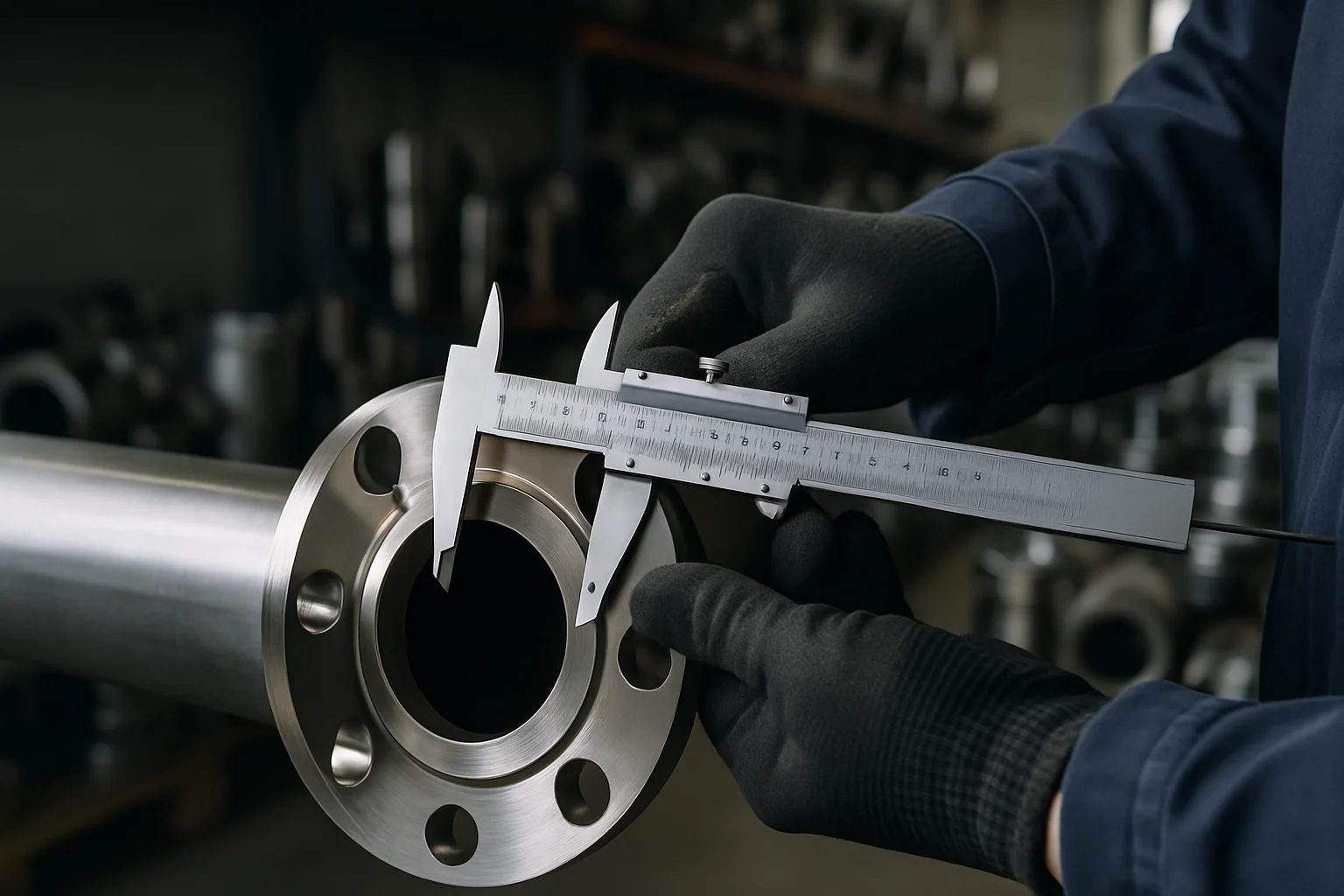
ASTM A312 TP321 Stainless Steel Pipes & Tubes
ASTM A312 TP321 stainless steel pipes and tubes (UNS S32100), titanium stabilised for service from 425 to 815 °C, stocked and exported by Riyaarth Overseas.
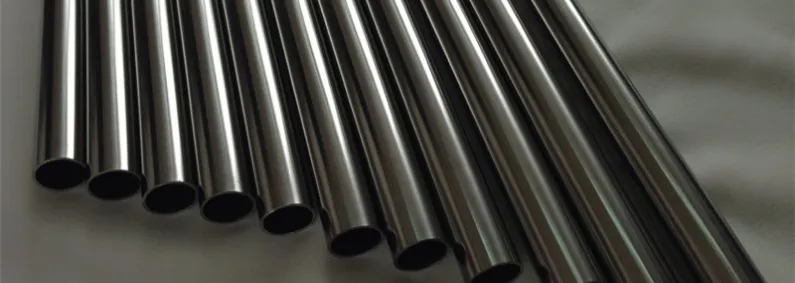
ASTM A312 TP321 (UNS S32100) is an 18/10 austenitic stainless steel stabilised with titanium. Titanium forms stable carbides, so chromium carbides do not form at grain boundaries when the steel is welded or held in the 425 °C to 815 °C range. This makes 321 resistant to intergranular corrosion after high temperature exposure, where plain 304 can become sensitised.
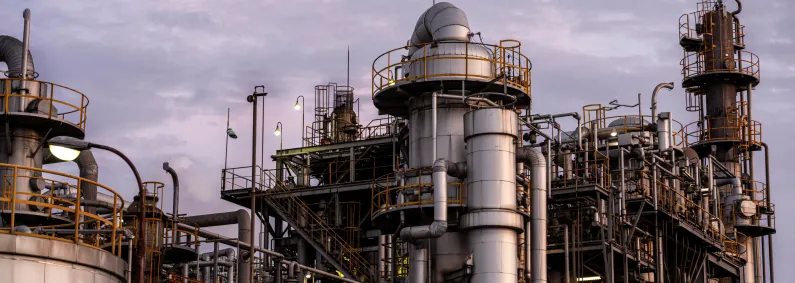
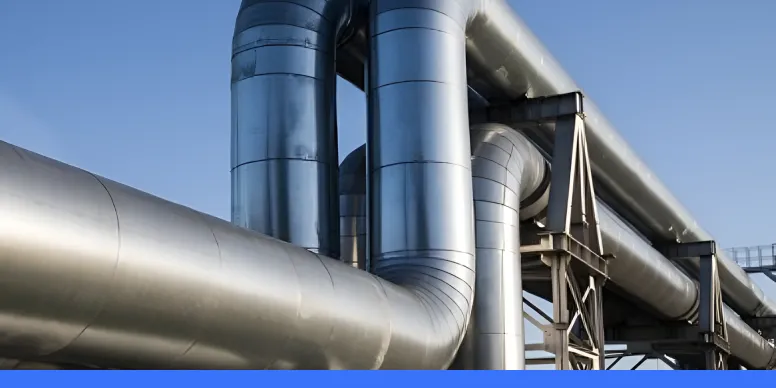
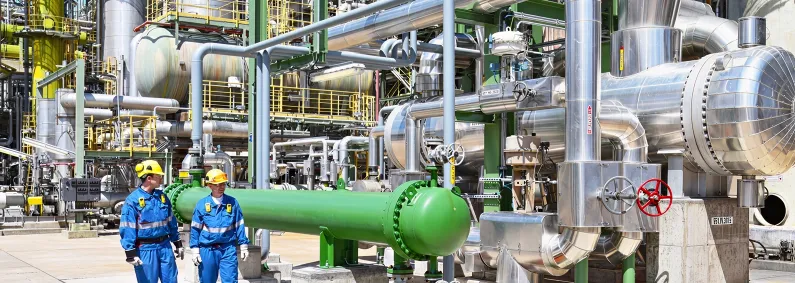
TP321 is used for hot process lines, exhaust systems and heat exchangers that run in the sensitising range. Riyaarth Overseas supplies and exports TP321 and TP321H seamless and welded pipes and tubes, with matching fittings and flanges if required.
Key Features
Titanium stabilised: Ti of at least five times carbon plus nitrogen keeps carbon out of solution and prevents sensitisation.
Good high temperature strength: Offers better creep and stress rupture properties than 304L in hot service.
Oxidation resistance: Resists scaling in air in the same range as 304, which suits hot gas and exhaust lines.
H grade option: TP321H (S32109) with 0.04% to 0.10% carbon is available for pressure parts in creep service.
Specifications
| Parameter | Details |
|---|---|
| Standards | ASTM A312 / ASME SA312 (pipe), ASTM A213 / SA213 and A249 / SA249 (tube), ASTM A269, ASTM A376 |
| Grades / UNS | TP321 (S32100), TP321H (S32109) |
| Outside diameter range | Pipe: 1/8 in to 24 in NPS; tube: from 6 mm OD upward |
| Wall thickness / schedule | Schedule 5S to 160 and XXS; tube wall to order |
| Length | Single random, double random and cut lengths |
| Type | Seamless and welded |
| Ends | Plain end, bevelled end, threaded end |
| Form / finish | Round; annealed and pickled |
| Test certificate | EN 10204 3.1 mill test certificate as standard; EN 10204 3.2 with third-party inspection on request |
Note that ASTM A312 sets lower minimum strengths for heavy wall seamless TP321 over 9.5 mm wall. Where a stabilising heat treatment is required, for example for refinery service, it should be stated in the order so that the mill can plan for it.
Chemical Composition
Limits per ASTM A312 for TP321.
| Element | Composition (%) |
|---|---|
| Carbon (C) | 0.08 max |
| Manganese (Mn) | 2.00 max |
| Phosphorus (P) | 0.045 max |
| Sulphur (S) | 0.030 max |
| Silicon (Si) | 1.00 max |
| Chromium (Cr) | 17.0 – 19.0 |
| Nickel (Ni) | 9.0 – 12.0 |
| Nitrogen (N) | 0.10 max |
| Titanium (Ti) | 5 × (C + N) min, 0.70 max |
Mechanical Properties
| Property | Value |
|---|---|
| Tensile strength, min | 515 MPa (75 ksi) for welded pipe and seamless up to 9.5 mm wall; 485 MPa (70 ksi) for seamless over 9.5 mm wall |
| Yield strength (0.2%), min | 205 MPa (30 ksi) for welded pipe and seamless up to 9.5 mm wall; 170 MPa (25 ksi) for seamless over 9.5 mm wall |
| Elongation in 50 mm, min | 35% longitudinal, 25% transverse |
| Hardness | HBW 192 max / HRB 90 max (ASTM A213, A249, A269 tubes) |
| Density | approx. 7.9 g/cm³ |
Equivalent Grades
| System | Designation |
|---|---|
| UNS | S32100 (321), S32109 (321H) |
| EN / Werkstoff | 1.4541 (X6CrNiTi18-10) |
| JIS | SUS321 |
| ASME | SA312 TP321 |
EN 1.4541 is the closest European grade to TP321. For the high carbon TP321H, check the project code, as EN grades with a matching carbon range differ.
Testing and Inspection
TP321 pipes and tubes are tested to ASTM A312 or the ordered tube standard.
- Hydrostatic or eddy current test: On every length.
- Intergranular corrosion test: ASTM A262 Practice E available, often requested for stabilised grades.
- Flattening and flaring tests: To confirm ductility.
- Positive material identification: Confirms titanium content and separates 321 from 304.
- Grain size check: For TP321H, as required by the standard.
- Third-party inspection: Witness inspection and EN 10204 3.2 certification on request.
Certificates show the titanium, carbon and nitrogen content so that the stabilisation ratio can be confirmed, and each length is marked with grade, size and heat number.
Why Choose Riyaarth Overseas
Riyaarth Overseas keeps TP321 pipes and tubes in common sizes and sources heavy walls and TP321H from reliable mills. Every supply is backed by EN 10204 3.1 certificates with heat numbers, cut to your lengths and packed for sea or air freight. Send your enquiry for a quick quote.
Applications
Frequently asked questions
What is the difference between 321 and 304?
321 adds titanium to tie up carbon. This prevents sensitisation when the steel is welded or held between 425 °C and 815 °C, where 304 can lose corrosion resistance at grain boundaries.
What is the difference between 321 and 347?
Both are stabilised grades. 321 uses titanium and 347 uses niobium (columbium). 347 is often preferred for welding consumables and for some high temperature services, as niobium is not lost in the arc as easily as titanium.
When is TP321H required?
TP321H, with 0.04% to 0.10% carbon and a controlled grain size, is chosen for pressure parts in creep service where the design code needs the higher allowable stresses.
Is 321 suitable for polished finishes?
321 can be polished, but titanium carbonitride particles may show on a fine mirror finish. For decorative polished parts, 304 is usually preferred.