
Stainless Steel Instrumentation Tubing
Stainless steel instrumentation tubing in 316/316L to ASTM A269 and A213, seamless, bright annealed, for compression fittings, from Riyaarth Overseas.
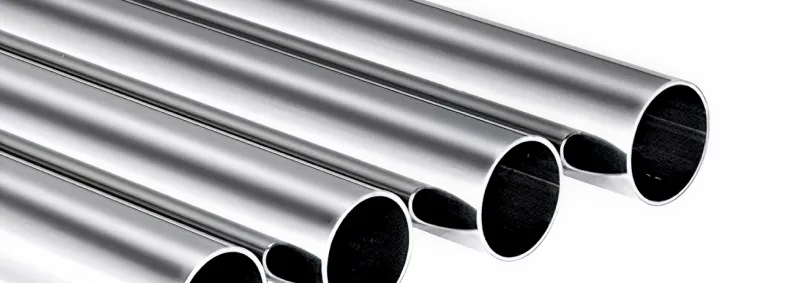
Stainless steel instrumentation tubing connects pressure gauges, transmitters, analysers and control valves to process lines. It is used with compression fittings and must be round, soft and smooth on the outside so that the ferrules grip and seal reliably. The most common choice is seamless 316/316L tubing to ASTM A269 or ASTM A213, fully annealed.
Instrument tubing is sized in inches, from 1/8 in to 1 in OD, or in metric sizes from 6 mm to 25 mm. Riyaarth Overseas supplies and exports instrumentation tubing in straight lengths and coils, with the hardness and finish that fitting makers recommend.
Key Features
Fitting friendly hardness: ASTM A269 allows up to HRB 90; compression fitting makers generally recommend HRB 80 max for a reliable seal.
Seamless and annealed: Seamless, fully annealed tube bends smoothly and resists cracking under the ferrule.
Clean finish: Bright annealed surfaces with no scratches across the sealing area.
Dual certified: 316/316L tubing meets both grades for strength and weldability.
Specifications
| Parameter | Details |
|---|---|
| Standards | ASTM A269 / ASME SA269, ASTM A213 / ASME SA213 |
| Grades / UNS | 316/316L (S31600 / S31603), 304/304L on request |
| Outside diameter range | 1/8 in to 1 in; 6 mm to 25 mm |
| Wall thickness / schedule | Common walls 0.035 in, 0.049 in, 0.065 in, 0.083 in; metric walls 1.0 mm to 2.0 mm |
| Length | Straight lengths, typically 6 m or 20 ft, and coils |
| Type | Seamless (welded on request) |
| Ends | Plain end, square cut, deburred and capped |
| Form / finish | Round; bright annealed, with outside surface free of scratches |
| Test certificate | EN 10204 3.1 mill test certificate as standard; EN 10204 3.2 with third-party inspection on request |
Choose the wall thickness from the fitting maker's pressure rating tables for the tube OD and service pressure. Order the hardness limit in writing, for example HRB 80 max, so that it is tested and reported on the certificate.
Chemical Composition
Limits per ASTM A269 for 316 and 316L. Dual certified tubing meets both.
| Element | Composition (%) |
|---|---|
| Carbon (C) | 0.035 max (316L), 0.08 max (316) |
| Manganese (Mn) | 2.00 max |
| Phosphorus (P) | 0.045 max |
| Sulphur (S) | 0.030 max |
| Silicon (Si) | 1.00 max |
| Chromium (Cr) | 16.0 – 18.0 |
| Nickel (Ni) | 10.0 – 14.0 |
| Molybdenum (Mo) | 2.00 – 3.00 |
Mechanical Properties
Strength minimums per ASTM A213 for dual certified 316/316L. ASTM A269 controls hardness only, and buyers usually add a lower hardness limit for fittings.
| Property | Value |
|---|---|
| Tensile strength, min | 515 MPa (75 ksi) for 316/316L dual certified (ASTM A213) |
| Yield strength (0.2%), min | 205 MPa (30 ksi) for 316/316L dual certified (ASTM A213) |
| Elongation in 50 mm, min | 35% |
| Hardness, max | HRB 90 per ASTM A269; HRB 80 commonly specified for compression fittings |
Equivalent Grades
| System | Designation |
|---|---|
| UNS | S31600 / S31603 |
| EN / Werkstoff | 1.4401 / 1.4404 |
| JIS | SUS316 / SUS316L |
For metric tube orders to European projects, EN 10216-5 1.4401 or 1.4404 may be specified in place of ASTM A269.
Testing and Inspection
Instrumentation tubing is tested on every length, with hardness given special attention.
- Hydrostatic or eddy current test: Every length is tested to ASTM A269 or A213.
- Hardness test: Confirms the tube meets the hardness ordered, usually HRB 80 max for compression fittings.
- Flattening and flaring tests: Check ductility and freedom from seam defects.
- Dimensional check: OD, wall and ovality measured against the order.
- Positive material identification: Confirms 316/316L.
- Third-party inspection: Witness inspection and EN 10204 3.2 certification on request.
Every length is marked with grade, size, standard and heat number, and the certificate reports measured hardness values along with chemistry and test results.
Why Choose Riyaarth Overseas
Riyaarth Overseas keeps 316/316L instrumentation tubing in common inch and metric sizes and sources other sizes from reliable mills. Every length is traceable to an EN 10204 3.1 certificate, ends are capped, and tubes are packed in wooden boxes or protective sleeves for export. Send your size list for a fast quote.
Applications

Frequently asked questions
Why is hardness important for instrumentation tubing?
Compression fittings seal by pressing the ferrules into the tube. If the tube is too hard, the ferrules may not grip and seal properly, so fitting makers recommend tubing well below the HRB 90 limit of ASTM A269.
Should I use seamless or welded instrument tubing?
Seamless tubing is the usual choice for high pressure and critical lines. Welded and redrawn tubing is acceptable in many lower pressure services if the fitting maker approves it.
What is dual certified 316/316L tubing?
It is tubing whose carbon meets the 316L limit and whose strength meets 316, so it can be certified as both grades.
Which sizes are most common?
In imperial sizes, 1/4 in, 3/8 in and 1/2 in OD with 0.035 in or 0.049 in walls are most common. In metric, 6 mm, 10 mm and 12 mm OD are widely used.